Deep learning, deeper healing with IPAT
I acknowledge the Kaurna people as the Traditional Custodians of the land where this workshop took place at Warriparinga. I pay my respects to Elders past, present, and emerging. Sovereignty was never ceded. I write this as a woman still learning about the depth of connection between healing, culture, and Country that Kaurna people have always known.
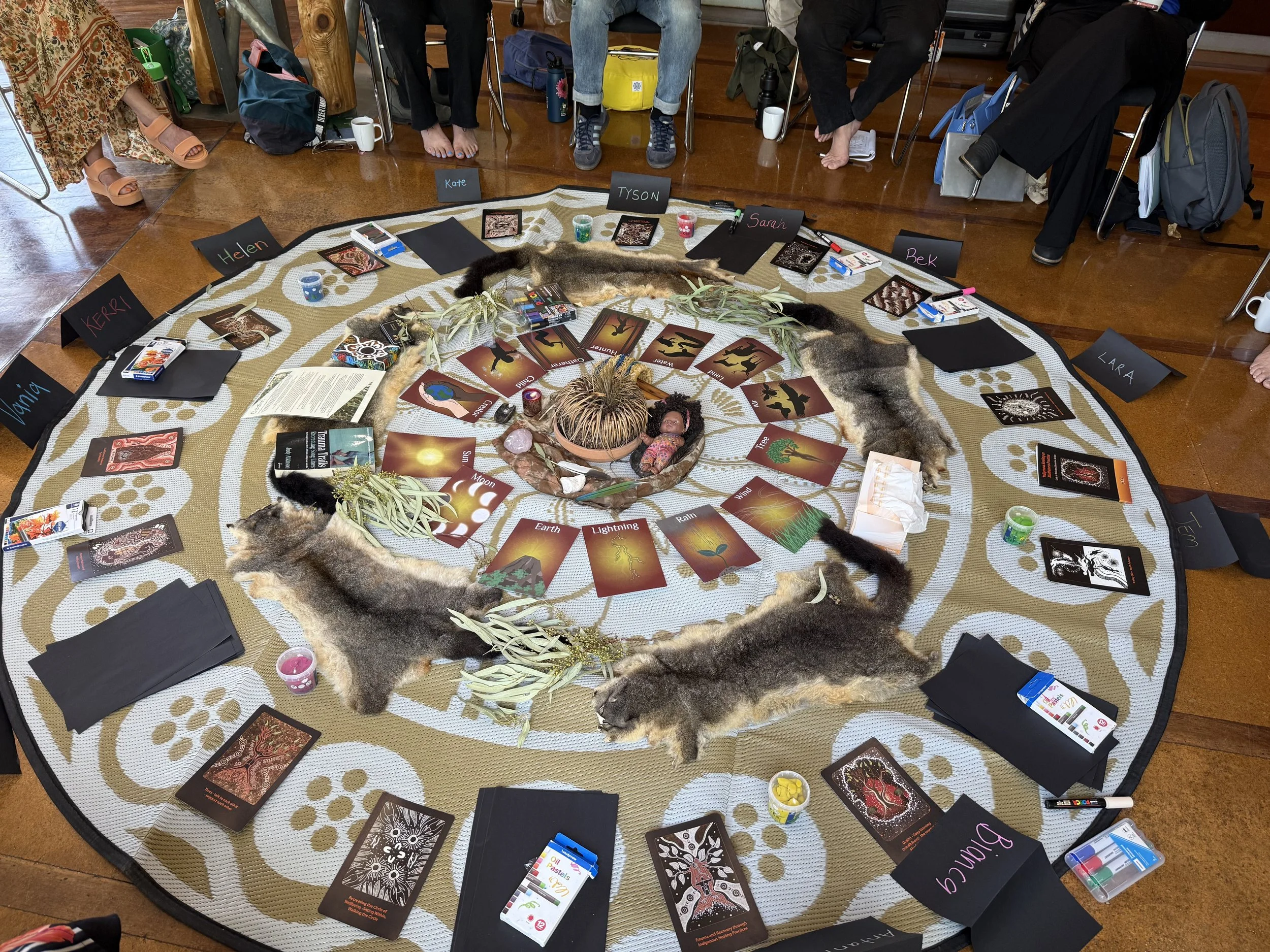
In March 2025, I attended Trauma Informed Care and Practice - An Indigenous Approach to Developing Worker workshop hosted by Indigenous Psychedelic Assisted Therapy (IPAT) in Kaurna Country at Warriparinga. This trauma-informed training was developed by Emeritus Professor Judy Atkinson AO and Dr Caroline Atkinson PhD, and facilitated by Jem Stone and Bianca Sebben.
Arriving late, arriving wound tight
I'm always late. Today it was the car battery. So I’m in a taxi my husband booked and gave the wrong address.
I exit the taxi walking and fumbling with my bag, drink bottle and notebook. I'm both participant and photographer for this workshop. Typical, I huff as I pull my self together. I was up late, I’d started painting my lounge room a completely different colour the evening before, because I can be constructively impulsive like that.
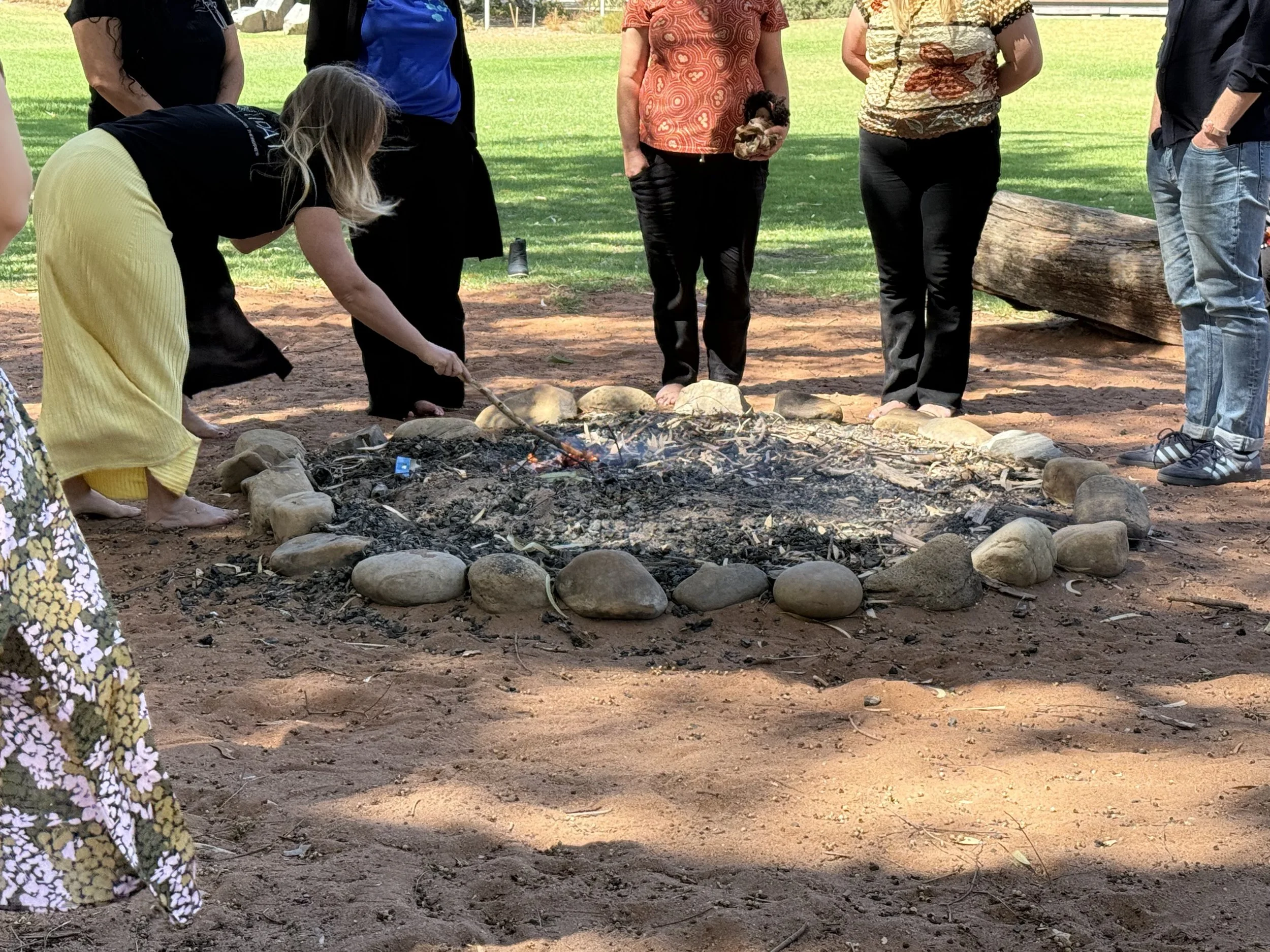
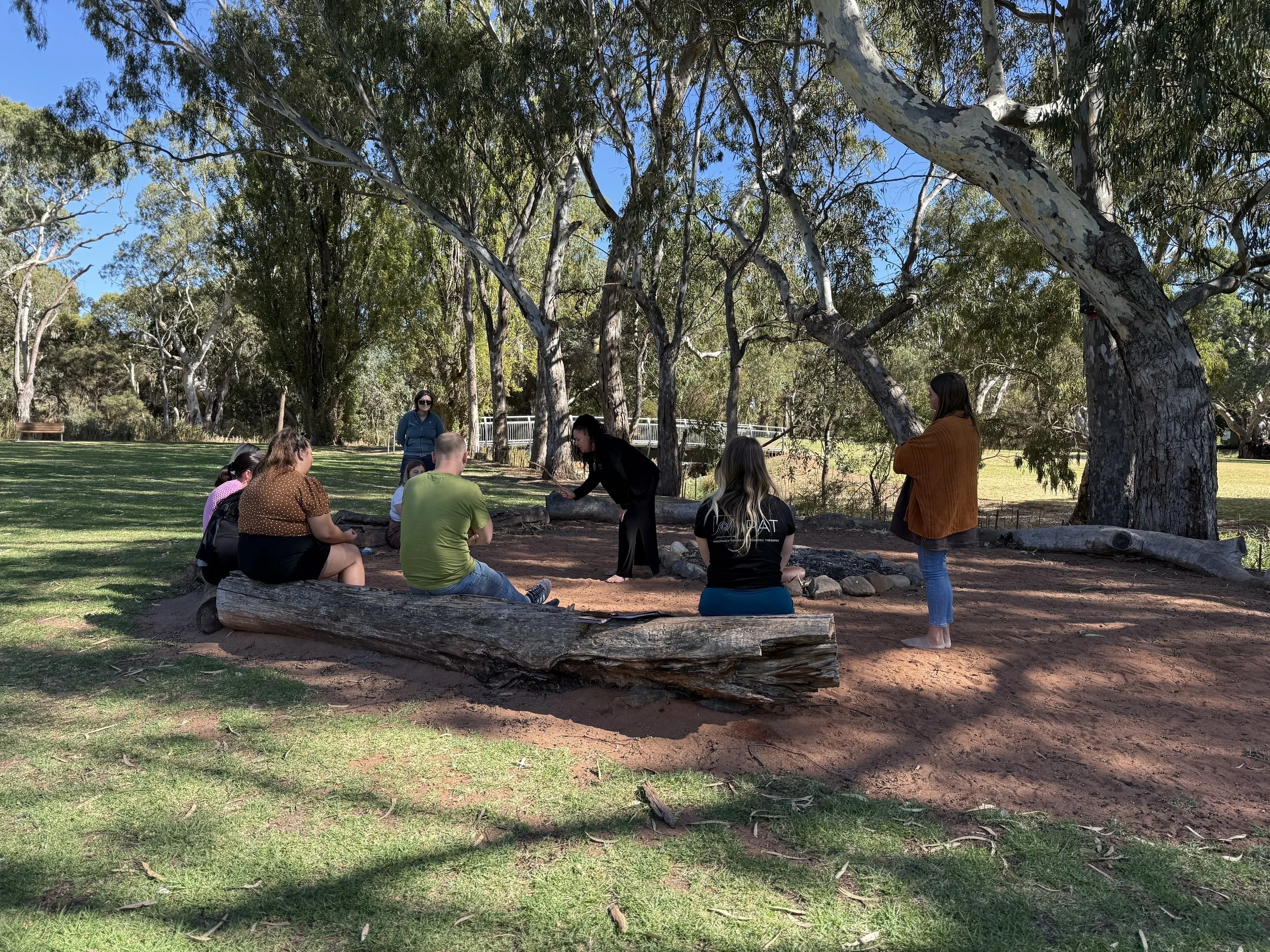
What struck me first about the venue was how lush and green it was, yet it was the end of a long and hot summer. I’d lived near by for years earlier and explored the walking paths near by but never knew it was here. It was quiet, somehow, even though we were in the heart of one of the busiest parts of town. We were surrounded by trees. There's even a fire pit there, built for ceremony.
My anxiety is bleeding through my peri-menopausal pores, my self-talk bordering belittling like my very own personal Lady Whistledown* as I make my way into the building.
* A Bridgeton - A TV show reference)
I walk into a group already seated in a circle. A familiar feeling of shame learned in my high school years floods through me as I interrupt whatever has already begun. But Jem and Bianca greet me warmly, assure me it's fine, I take a seat beside Bianca.
During a break in conversation an Aunty leans over. "Geez girl, are you a bit uptight?"
I look down, I’m pressed into my seat like I hope no one can see me. My body is tight, my legs coiled around the chair legs like I'm trying to become one with the furniture. My shoulders are sitting somewhere near my ears and I can feel the burn as I realise the energy and body language I'm projecting: I am an anxious creature, don't touch or talk to me. Which is not what I generally like to project despite how it may seem on the outside. I laugh and unwind my body and drop my shoulders, just a little.
I relax. I sink into what becomes some of the most lovely, deeply connected, energetically warm space I've sat in.
We met at Warriparinga, an important cultural heritage site For the Kaurna people of the Adelaide plains, this is a traditional ceremonial meeting place, and still used today, I believe. It’s an important part of the Tjilbruke Dreaming.
The workshop offered practical, tools for working with ourselves in collaboration with First Nations people and diverse communities in ways that honour their culture, their lived experience of their culture, our lack of, and the on going resilience needed to hold onto what feels absent. But more than that, it offered something I didn't expect: a complete reframing of how I understand trauma, healing, and my own place in both.
Symptom as history
The training introduced Professor Atkinson's concept of "Symptom as History," a framework that recognises trauma responses as echoes of generational and systemic impact (Atkinson, 2002).
Like many people would say, I've always known very little about the ongoing systemic issues and atrocities Indigenous people face. My education was brief, sometimes out dated inaccurate and virtuous in the early 90’s Australian School system, I am unsure of how it compares now. I even found some university courses lacked what I was looking for. I wanted to learn more deeply about the impacts that our restrictive policies, systems, rules, guidelines and norms continue to go against what I learned on this day. History built on common sense, and respect for nature and each-other. I'd never had so many moments of clarity about the negative effects stemming from colonisation.
And it feels some-what vulnerable perhaps embarrassing or ignorant to admit, I'd only ever considered it a problem for those directly affected by colonisation, not something that touched my own world. I hadn’t made time to look deeper.
The history everyone of us carries what is now being mirrored in our socio-ecological system.
This course helped me embody, comprehend, and connect the dots. Colonisation hasn't just impacted First Nations communities.
From ceremony to system: when rules interrupt the sacred
We held a small fire. A ritualisation, ceremony, a circle. The facilitators had arranged it as part of an activity, explained its purpose and meaning. But even there, the rules intervened. A young member of staff approached me as I snapped photos (see gallery Below). She quietly asked me to have me let the facilitators know, “You haven’t approval for the fire, you can’t do that”.
We were at a place specifically designed for this kind of cultural work, on Kaurna land, thats what it was booked for. I giggled inside, one would assume the fire pit was for a fire especially with those not so old coals inside.
I smiled and said, “You go tell Jem to put it out then.” Holding back the oppositional 13 year old me tightly inside. I wanted to ask,’ who are you to tell them it's safe or not safe to proceed’, I am not even sure if you know how to use a box of matches young lady… But I didn’t because I am her, and she is me just doing what everyone else does. Trying to be a good girl. I shrugged and watched on as she slowly crossed the lawn and cautiously approached the group and this small moment, and it contained everything we were there to learn about. Here we were, gathered to understand trauma-informed, culturally grounded healing, and in walked the exact problem we'd come to examine.
This is what systemic interruption looks like. Not always loud or dramatic. Sometimes it's just someone doing their job, follow the rules or the system comes for you too, all while not realising we are all enacting the very disconnection we're trying to heal to learn about and from.
Do they not think we want the best for ourselves? Do they not think Indigenous cultures across the world want safety and care too?
We do not want to burn it all down, just a small fire with some post it notes thanks. Side Note: we may or may not have put the fire out…
This is what the friction between imposed systems and cultural healing actually looks like. Not abstract. Not theoretical. Just someone doing their job, following the rules, needing to assert authority even when everyone in the room knows it doesn't make sense.
I found it deeply unsettling.
The things I got wrong or right?
Depending how your relationship with critique is…
During one of the activities, I said something I thought was helpful. I'd heard Brené Brown say something once about white women in leadership spaces needing to step back to allow others to step in. Or at least, that's how I'd interpreted it. One of the facilitators called this out. Gently. Thoughtfully. I replayed that moment in my brain most of the drive home.
What if everyone should have a place at the table? Not stepping back, not stepping forward. Just... a place. That no one has to make or fight for?
I've sat with that for months now.
Because here's what I was doing: I was still centering white frameworks. It felt ignorant looking back on it. For the similar reasons I find it annoying to listen to men speak about womens health.
I was assuming that Brown's "courage culture" applied universally, that her teachings on vulnerability and leadership were the baseline from which everyone else should operate.And thats not bad necessarily because had I not engaged with that, I may never had had that lesson.
But as Dr. Carey Yazeed points out in her critique of Brown's work, the cost of courage for Black people in America is fundamentally different. It's about finding the courage to speak out against racism, to protest the killings of innocent people, to fight for equality in a country that hates their existence. Brown's research participants were predominantly white. Her frameworks emerged from white, middle-class experiences of what it means to be vulnerable, to be brave. Its a weird place to
When I apply those frameworks to spaces where Indigenous people are navigating ongoing colonisation, where the "courage" required is to survive systems and become part of something designed to erase them, I'm not being helpful. I'm unconsciously supporting the same structures we are there to examine.
The facilitator was right. Indigenous people don't need white women to step back or step forward. They need us to recognise that they've always had their own frameworks for courage, vulnerability, collective healing, and leadership. Frameworks that existed for thousands of years before Brené Brown published her first book.
My job isn't to perform allyship by strategically removing myself or anyone else. It's to stop assuming my/ our framework is the default.
There's so much I still don't know.
I cried several times over those two days. I sat with my grief. Grief for the stories I'll never fully understand, for things that can never be returned, for the ways trauma moves through generations, for the resilience carried in bodies, spirits, and lineages not my own. And for the depth of damage done and the work that still needs to be done.
I have witnessed, again and again over the past 10 years, the power of healing in community in the presence, story, in these short moments shared in groups and in brief encounters, but I was still surprised. In what I learned about my place. In two days, our group became a little community of people who would likely never see each other again, yet we connected deeply enough to offer each other a soft spot to sit in silence or in noise and discomfort.
Our facilitators, Jem Stone and Bianca Sebben, created a space that held space for deep consideration and reflection. They encouraged us to be curious, to feel safe asking hard questions and making even harder statements about ourselves and our understanding of spaces many of us (like me) feel fear or shame stepping into, worried about criticism and ridicule.
They showed us how to hold space in ways that are relational, not hierarchical. The respect for each of us was obvious. There was no need for those more virtuos parts to show themsleves.
Sit down Lady Whistleton, be humble.
Braiding narratives: psychedelic healing across clinical and community
What I experienced in this workshop mirrored conversations happening in the psychedelic space which is where I have spent much of the past 8 years in various roles with the Australian Psychedelic Society. Psychedelic-assisted therapies are increasingly recognised for their potential to address conditions like PTSD, depression, and end-of-life anxiety. Australia became the first country to reschedule psilocybin and MDMA for authorised therapeutic use in July 2023, yet access remains tightly restricted, with fewer than 25-30 psychiatrists currently approved to prescribe them.
In the underground, it continues to thrive. It's held in living rooms, forests, and community spaces, where people gather to sit in ceremony, guided by peers, elders, or facilitators. These spaces often prioritise integration, embodiment, connection to Country, and display somewhat tokenised or stolen ancestral wisdom. Often inaccurately done.
The tension between these two worlds (clinical and community) can be contentious and difficult to navigate for some, but it does does not need to be a conflict, but a I think rather its a call for reconciliation and deep listening. Each realm has something important to offer.
Giving back? Reciprocity in action
As the psychedelic field grows (clinically and underground), we're all being asked to reflect on how we engage and what we do when we engage.
How do we give back to the communities and cultures from which these medicines and practices arise?
How do we honour not only our own healing but the collective healing of the lands we live on?
How do we?
Indigenous representation in psychedelic-assisted therapy requires moving beyond tokenistic displays of inclusion and naturally towards genuine partnership and reciprocity. And I still consider months later, what that even means for me, as an individual and in my various roles.
Without it this cosideration, we repeat the same harms in new forms, and this will echo heavily through history. This is something we could all work toward, myself included.
This workshop is designed to have you considering and provides frameworks based on lived experience and compassion for what we cannot know of what is not known.
“ Deep wounds bleed”
Who is IPAT and why this work matters
Indigenous Psychedelic-Assisted Therapies (IPAT) is a small, independent Indigenous-owned business operating under the We Al-li Sovereign Business Model. Their mission is clear: to ensure there is cultural safety, accessibility, and Indigenous representation in the emerging field of psychedelic-assisted therapy.
IPAT is driven by values of community, connection, reciprocity, integrity, and transparency. They're not just talking about bridging the divide between Western and Indigenous knowledge systems. They're actively doing it through education and training, consultation, and advocacy.
Their work is all about improving collective health and wellbeing for entire communities. They understand that healing isn't just individual. It's relational, intergenerational, and connected to land and culture. Recently, IPAT published research in the Australian and New Zealand Journal of Public Health, articulating an Indigenous approach to decolonising psychedelic-assisted therapy.
This is lived experience and practice, informed by cultural knowledge and a commitment to transforming how we understand and respond to trauma and disconnection.
What you'll learn in the Trauma Informed Care and Practice - An Indigenous Approach to Developing Worker Skills
The IPAT training covers essential ground for anyone working in health, community services, education, or simply wanting to understand trauma and healing more deeply:
Understanding "Symptom as History" and how trauma is stored in the brain and body
Working effectively with Indigenous young people and communities
De-escalation strategies and recognising behaviour as language
Indigenous healing practices and what they actually look like
Conducting trauma audits using genograms and loss history maps
Story mapping and how the history of place strengthens responses
Unpacking cultural safety, cultural sensitivity, cultural competency, and what they all mean in practice
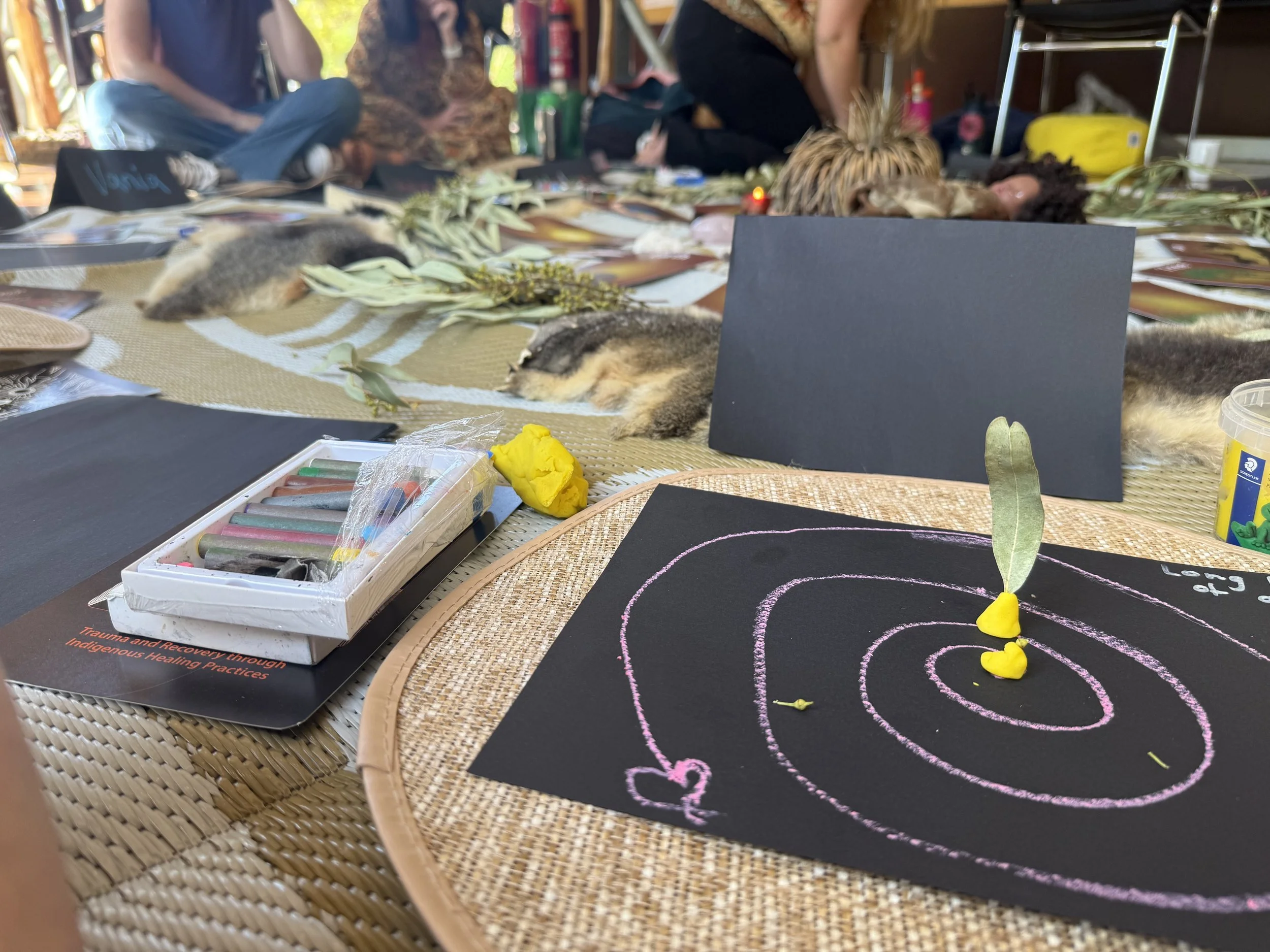
Experiential and interactive activities including art, dance, drama, music, song, and massage therapies
Effective yarning circles and action planning
Self-care practices, debriefing, and how to minimise and respond to vicarious trauma and burnout
Strengthening integrative service responses and developing communities of care within communities of practice
This training wasn't about "helping" communities. It was about the interconnected-ness of us with nature.
See the next training session for 2026 via the IPAT website
Why you should consider this training
If you work in mental health, community services, education, or any field where you encounter trauma (and let's be honest, that's most of us), this training will change how you understand and respond to it.
If you're involved in the psychedelic space in any capacity, whether clinically or in community, this training offers essential grounding in cultural safety and Indigenous perspectives that should inform this work.
If you've ever felt unsure about how to respectfully engage with Indigenous knowledge systems, or worried about getting it wrong, Jem and Bianca create a space where you can ask those hard questions without judgment.
This isn't a workshop where you sit and take notes. You get to participate within your own boundaries. You feel an lot and it’s weirdly fun. You leave changed.
And perhaps most importantly, by supporting IPAT's work, you're supporting Indigenous representation and leadership in spaces where it's needed.
In gratitude and invitation
With deep thanks to:
We Al-li – provides a Culturally Informed Trauma Integrated Healing Approach (CITIHA) to training for individuals, families, communities and organisations.
It presents on informed Indigenous and non-Indigenous practices from which new theories are presently evolving. Our education and training packages move beyond the mental health services delivery model and into a socio-cultural model of health which skills and empowers workers for personal and community developmental approaches for individual and group wellbeing.
Wayapa Wuurrk – was created to change thinking around how we view the idea of what it means to be well, nurturing the development of holistic wellbeing and sustainable behaviour. The philosophy acknowledges and honours the fundamental Australian indigenous principle of ‘Caring for Country’. In other-words, to foster a deeper understanding and responsibility to sustainably connect with and care for, the earth, across the lands, waters, air spaces as well as all beings between.
To Jem, Bianca, the team at IPAT, and everyone who showed up with openness.
If you're interested in upcoming IPAT trainings, or more information you can find them at:
IPAT website: ipat.au
Email: ipatherapies@gmail.com
References
Atkinson, J. (2002). Trauma trails, recreating song lines: The transgenerational effects of trauma in Indigenous Australia. Spinifex Press.
Atkinson, J. (2020). Symptom as History, Culture as Healing: Incarcerated Aboriginal Women’s Journeys Through Historic Trauma and Recovery Processes.
Sebben B, Stone J, Sarris J, Perkins D, Mallie K, Barnett S, Ruffell SGD, Beesley VL. Psychedelic medicine and cultural responsiveness: A call for Aboriginal and Torres Strait Islander engagement in Australian clinical trials and practice
Yazeed, C. (n.d.). The dangers of courage culture and why Brené Brown isn't for Black folk. Dr. Carey Yazeed. https://drcareyyazeed.com/the-dangers-of-courage-culture-and-why-brene-brown-isnt-for-black-folk/